
The World Champion Is the Underdog: Why Ratings Don't Decide Title Matches

When Gukesh Dommaraju defends his world title in Geneva from 24 November, he will be the lower-rated player by 72 points. Challenger Javokhir Sindarov is rated 2782 and ranked fourth in the world, while Gukesh is rated 2710 and ranked 26th. Magnus Carlsen has called Sindarov a significant favourite, and betting markets give the challenger a 63–73 per cent chance.
Sindarov deserves to start as favourite. But ratings measure tournaments, and a world championship is a match. Rating arithmetic gives Gukesh roughly a one-in-ten chance. The record since 2000 points to something nearer one in four.
Two players heading in opposite directions
Sindarov won the 2025 World Cup, then won the 2026 Candidates unbeaten with 10/14. Gukesh's rating has fallen from its peak of 2794 in October 2024. He finished last at Norway Chess in June with five losses and scored 2/7 at the Chennai Grand Masters. His best 2026 result was 8.5/10 on board four at the Olympiad, before a final-round loss.
The match is up to 14 classical games. The first player to 7.5 points wins, and a 7–7 score goes to faster tiebreak games.
What the ratings predict
Under the Elo tables behind FIDE ratings, a 72-point gap means the favourite should score 60 per cent per game. Treat the 14 games as independent and assume 60–70 per cent are drawn. On those numbers, Sindarov wins the classical games outright about 85–89 per cent of the time, and Gukesh's chance of keeping the title is roughly 7–11 per cent.
The betting markets give Gukesh 29–37 per cent, about three times as much.
What history shows
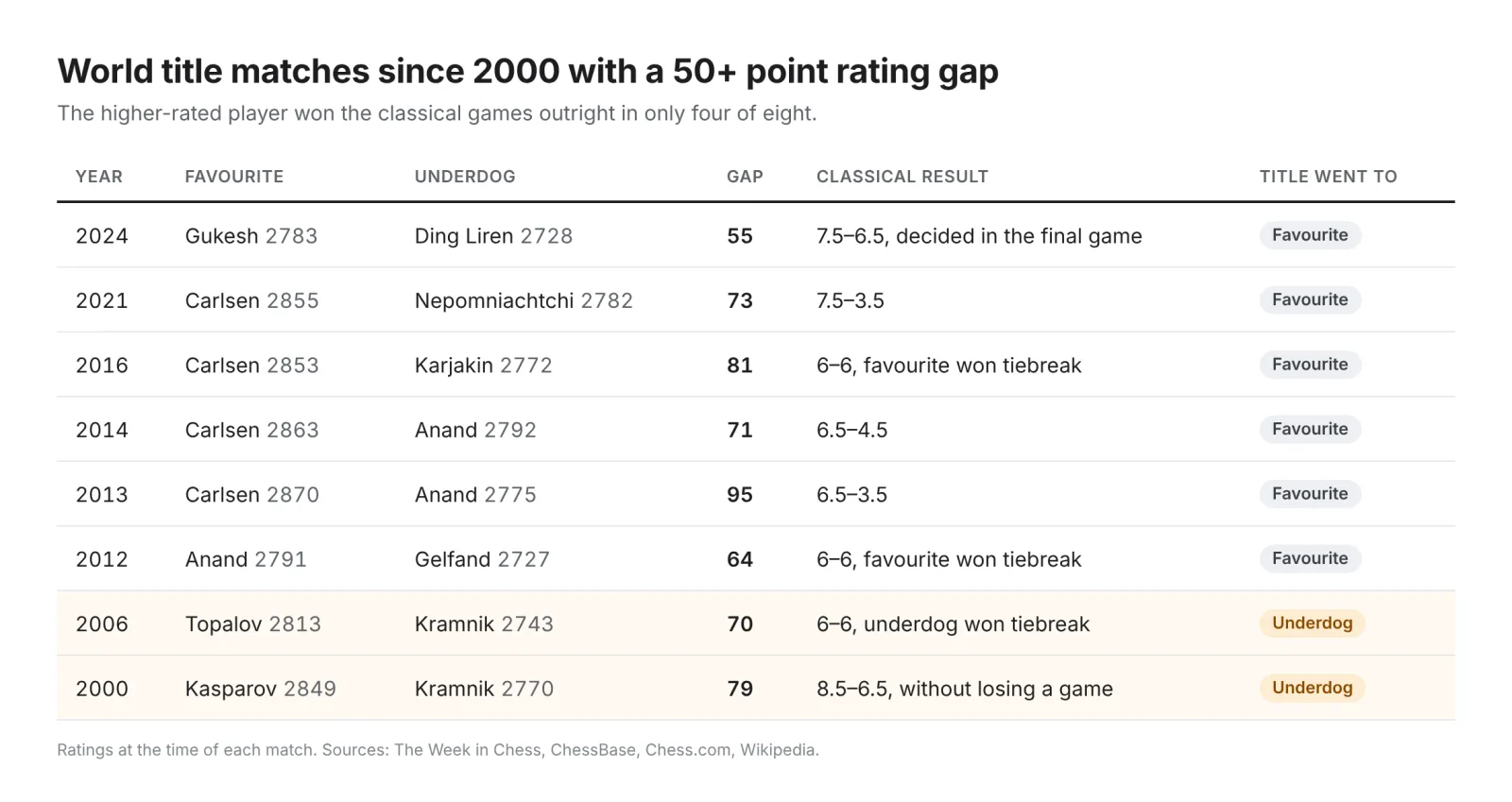
Since 2000, eight title matches have been played between players rated 50 or more points apart. The favourite won the classical games outright in only four of them.
Underdog won 8.5–6.5
The underdog won the title twice in eight matches, or 25 per cent, close to the market's price. Eight matches is a small sample, but the pattern has clear causes.
Why matches defy ratings
Preparation targets one person. In 2000, Kramnik neutralised Kasparov with the Berlin Defence and a new idea in Kasparov's favourite Grünfeld, prepared specifically for him. A rating cannot account for a surprise built for one player.
A few games decide everything. Most elite match games are drawn. Carlsen and Karjakin played only two decisive classical games in 2016. When one or two results decide the title, chance helps the weaker side.
Results carry over. In a match, you face the person who just beat you. Carlsen says that whoever leads early becomes the favourite: "That's how these matches work." In 2021, Nepomniachtchi drew the first five games, lost the 136-move Game 6, then lost three of the next five.
The case for Sindarov
The gap this year is not a statistical quirk. Sindarov went unbeaten through his two biggest events, while Gukesh's losses have come in clusters, which is exactly the weakness that decided 2021. Rapid chess is also not regarded as one of Gukesh's strongest formats, which matters in a tiebreak.
What to watch
Watch the first decisive game, not the rating gap. If Gukesh wins it, an upset becomes realistic. If Sindarov wins it, the risk is a repeat of 2021.
The lesson holds at every level: against a known opponent, preparation and the ability to recover after a loss matter more than the rating gap. Studying your own tournament games, the approach behind The Chess Scholar's game-analysis sessions, is where that work starts.